Catamaran vs Monohull Charter: What Fits?
Catamaran vs monohull charter: compare space, comfort, sailing feel, budget, and routes to choose the right yacht for your next trip.
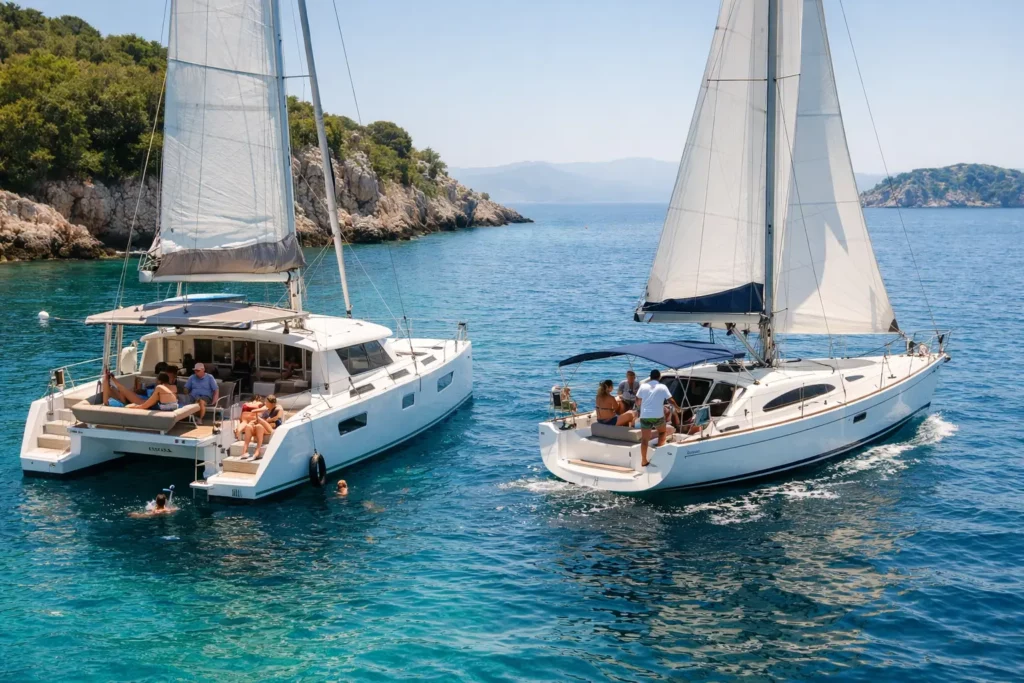
You usually feel the difference before you understand it on paper. Step aboard a catamaran and the first impression is width, stability, and a floating terrace lifestyle. Step onto a monohull and the feeling shifts – more connected to the water, more classic, and often more like what people imagine when they picture a real sailing yacht. If you are weighing a catamaran vs monohull charter, the best choice is not about which boat is better. It is about which boat fits your holiday, your group, and the kind of time at sea you actually want.
For some guests, that answer is obvious. For others, it only becomes clear after looking at how they plan to sleep, cook, move around, anchor, and sail. The right yacht can make a week feel effortless. The wrong one can make a beautiful destination feel harder than it needs to.
Catamaran vs monohull charter: the real difference
At the simplest level, a catamaran has two hulls and a much wider footprint. A monohull has one hull and the traditional sailing profile most people recognize immediately. That design difference affects almost everything onboard, from motion and privacy to marina costs and the way the yacht handles under sail.
A catamaran usually wins on usable living space. You get a broad cockpit, a salon on one level, and often generous cabins in both hulls. It tends to feel more like a villa on the water. For families, mixed-age groups, or guests who want long lunches at anchor without much rolling, that matters.
A monohull usually wins on sailing character. It heels, responds differently to the wind, and gives many guests a more engaging connection to the sea. It can also be easier to find at lower price points, especially if your priorities are classic sailing and access to a broad range of charter options.
Neither is automatically the smarter choice. A romantic couple cruising from cove to cove has different needs than two families sharing a skippered yacht for a summer week.
Space and comfort onboard
This is where catamarans tend to pull ahead for vacation-focused charters. The beam creates room you can feel all day long, not just in the brochure. There is more space to spread out, more separation between cabins, and usually less of that everyone-is-in-everyone-else’s-way feeling.
That layout is especially helpful for families with children, groups of friends, and guests booking with a skipper and possibly a hostess or chef. When more people are living onboard, privacy quickly becomes a luxury. On a catamaran, each hull often gives cabins a bit more independence, and the common areas feel social without becoming cramped.
Monohulls can still be very comfortable, especially modern models with smart interiors, but comfort onboard is different. Space is organized more vertically and more tightly. Cabins may be cozier, the salon more compact, and movement through the boat more noticeable when everyone is getting ready at once. Some guests love that intimacy. Others find it less relaxing over a full week.
Motion at sea: stability vs sailing feel
If anyone in your group worries about seasickness, the catamaran deserves serious attention. It generally stays flatter at anchor and under way, with less side-to-side rolling in many conditions. For guests new to chartering, that can be the deciding factor. Breakfast is easier, sleep is often better, and time at anchor tends to feel calmer.
A monohull moves more. It heels when sailing, which is part of the pleasure for experienced sailors and part of the uncertainty for first-timers. That movement is not a flaw – it is the nature of the boat. Many sailors would say a monohull feels alive in a way a catamaran does not. If your idea of a perfect charter includes the sensation of the yacht working with wind and water, a monohull often delivers that in a more traditional way.
The trade-off is simple. Catamarans are often more comfortable for non-sailors. Monohulls often feel more rewarding for guests who want the sailing itself to be part of the experience, not just the transport between bays.
Budget matters more than people expect
When comparing a catamaran vs monohull charter, price is rarely just the base charter fee. Catamarans often cost more to charter because they offer more volume and are in high demand with leisure groups. In many marinas, their width can also mean higher mooring fees. Fuel, provisioning patterns, and onboard extras can shift the total further.
Monohulls are often the more accessible option if budget is a key factor. That does not mean compromising on quality. It often means putting your money into destination, season, or trip length instead of platform size. A well-chosen monohull in a great cruising area can deliver a better overall holiday than stretching too far for a catamaran and then cutting corners elsewhere.
This is where good charter advice really matters. Guests sometimes focus on nightly rate and miss the bigger picture – group size, cabin expectations, skipper arrangements, and how much time they will actually spend sailing versus anchored. A slightly more expensive boat can be better value if it fits the group naturally. A cheaper boat can become the expensive mistake if everyone feels crowded by day two.
Which yacht works best for your group?
For couples, the answer depends on style. If you want a classic, more intimate sailing holiday and do not need much extra room, a monohull can feel romantic and elegant. If you want easy movement, sunbathing space, and a relaxed platform for swimming and dining, a catamaran may feel more indulgent.
For families, catamarans are often the easier recommendation. Parents tend to appreciate the stable platform, the larger social areas, and the sense that children have room to move without the boat feeling tight. It is not about luxury for its own sake. It is about making daily life onboard smoother.
For friend groups, the right answer depends on how social the trip is meant to be. Catamarans support a floating beach-club rhythm very well – music, shared meals, paddleboards, long afternoons at anchor. Monohulls suit groups that care more about the sailing journey and are happy with a slightly closer onboard dynamic.
For experienced sailors, a monohull often remains the emotional favorite. For mixed groups with non-sailors, catamarans usually win on harmony.
Best routes and destinations for each style
In the Mediterranean, both yacht types can work beautifully, but local conditions do matter. If your plan includes plenty of anchoring in calm bays, swim stops, and leisurely coastal cruising, a catamaran often feels tailor-made for that rhythm. Greece, Croatia, and parts of Italy can be wonderful for this style of trip, especially when the holiday is as much about time onboard as time ashore.
A monohull can be a particularly satisfying choice in areas where sailing legs are part of the pleasure and marina access matters. It may also suit travelers who want a more classic island-hopping feel and do not mind a little more motion in exchange for a more connected ride.
Your route should influence your boat choice, not the other way around. Wind patterns, marina availability, group confidence, and whether you plan to charter with a skipper all shape what will feel easy and enjoyable.
Catamaran or monohull charter for first-timers?
First-time guests often assume they should pick the larger-feeling boat, and many times that instinct is right. A catamaran is frequently easier to love immediately. It feels stable, spacious, and straightforward as a vacation setting.
But first-timers should not rule out monohulls too quickly. If the group is small, budget-conscious, and genuinely interested in sailing rather than simply floating in comfort, a monohull can be the more memorable choice. The key is honest expectations. If someone in the group dislikes tight spaces, values private cabins, or worries about motion, forcing a monohull for the sake of price may not be worth it.
This is one reason human guidance still matters in yacht chartering. The best recommendation usually comes from asking a few practical questions: Who is coming? How important is comfort at anchor? How much sailing do you actually want? Are you imagining long lunches on deck, or are you chasing that classic heel-under-sail feeling? Those answers tell you more than any brochure ever will.
So which one should you book?
Choose a catamaran if your priority is space, stability, easy group living, and a relaxed holiday feel. Choose a monohull if your priority is sailing character, a lower starting budget, and a more traditional connection to the sea. If you are still split, that is normal. The best charters are built around people, not categories.
A great yacht should feel like it was chosen for your trip, not just selected from a list. When the boat matches the group, the route, and the pace you want, everything else starts to click – mornings at anchor, dinners in quiet harbors, and that rare holiday feeling where the days finally stop rushing past. If you are unsure, start with the experience you want to remember, and let the yacht type follow from there.