Guide to Yacht Cabin Layouts for Charter Groups
Our guide to yacht cabin layouts helps couples, families, and friends choose the right space, privacy, and comfort for memorable charter vacations at sea.
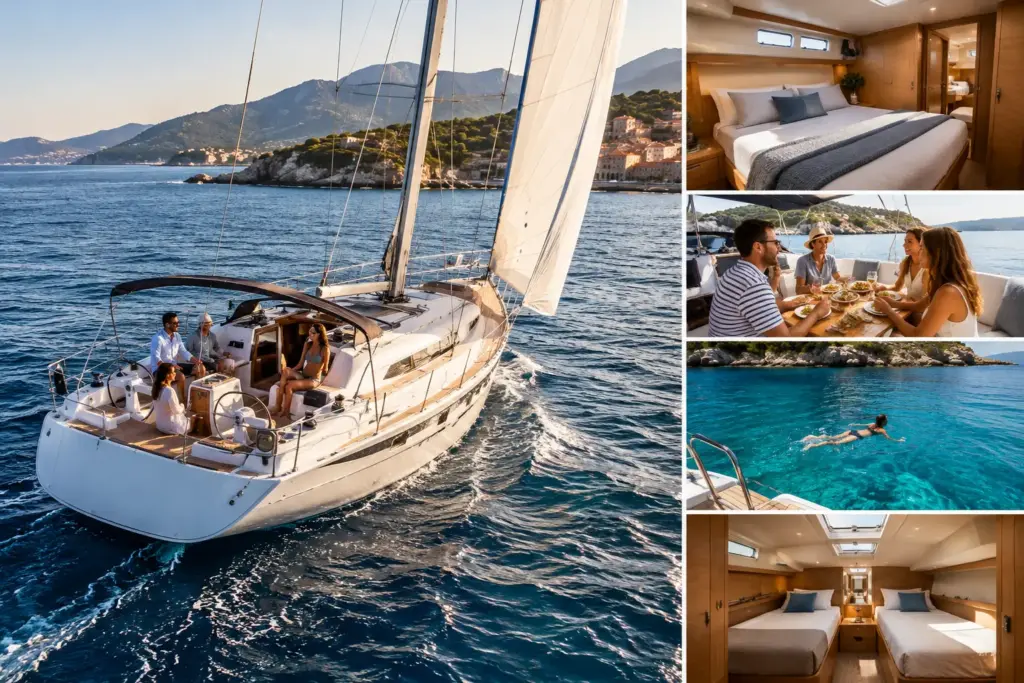
The first surprise on a yacht is usually not the view from the cockpit. It is how much the cabin plan shapes every hour of the trip: where everyone sleeps, who gets privacy, whether bags have a place to disappear, and how easily a family can settle in after a swim. This guide to yacht cabin layouts will help you choose a boat that feels right for your group, not merely one with enough berths on paper.
A well-matched layout turns a sailing vacation into easy mornings, relaxed afternoons, and comfortable nights in beautiful anchorages. A poor match can make even a spectacular route feel crowded. The right choice depends on your group dynamic, your comfort expectations, and whether you plan to sail independently or with a skipper.
Guide to Yacht Cabin Layouts: Start With How You Travel
Before comparing cabin counts, consider the people sharing the boat. Two couples may prefer equal en-suite cabins. A family may be happier with a spacious owner’s cabin for the adults and a smaller cabin for children. A group of friends might prioritize as many separate sleeping spaces and bathrooms as possible, even if the saloon is more compact.
Also think about your daily rhythm. If your group loves long dinners onboard, a generous cockpit and saloon may matter more than a larger forward cabin. If you expect to spend most days ashore and use the yacht as a base between beaches and coastal towns, compact cabins can be a perfectly smart trade-off.
Charter listings often show the number of cabins, heads, and berths. Those figures are useful, but they do not tell the full story. Ask whether cabins have private bathrooms, whether a berth is a real bed or a convertible saloon, and how much standing room and storage each cabin offers.
The Main Yacht Cabin Layouts You Will See
Monohull sailing yachts
A monohull sailing yacht typically has cabins arranged below deck, with the galley and saloon in the center and sleeping cabins at the bow and stern. On many 40- to 50-foot models, the most common arrangement is three or four cabins.
A three-cabin monohull often provides two aft cabins with good-sized double berths and one forward owner’s cabin. This can be an excellent choice for two or three couples, or for a family that values a more comfortable primary cabin. The trade-off is simple: fewer cabins usually means more personal space.
Four-cabin monohulls use the available hull space more intensively. They are popular with friend groups because they can sleep eight people in separate cabins. However, forward cabins may be narrower, and some layouts use bunk beds or smaller berths. For an active group focused on sailing, swimming, and exploring destinations such as Greece or Croatia, that compromise may be worthwhile. For guests who value a hotel-style room, it may not be.
Catamarans
Catamarans are often the easiest layout for first-time charter guests to understand because their two hulls create natural separation. Cabins are usually located in each hull, while the saloon, galley, and cockpit sit above the waterline between them.
A four-cabin catamaran is a favorite for four couples or larger families. Each cabin is generally more private than on a monohull, and many have en-suite bathrooms. The wide beam also creates an airy saloon and a large outdoor living area, which makes a real difference when everyone gathers for breakfast or a sunset drink.
Some catamarans have an owner’s version layout. Instead of two cabins in one hull, that hull becomes a larger private suite with more storage, a desk or sitting area, and often a more generous bathroom. This is ideal for a couple traveling with children, friends, or a skipper, but it is less suitable when every adult couple expects identical accommodations.
Catamarans do have trade-offs. They are often priced higher than comparable monohulls, and marina fees can be greater in some destinations because of their width. Yet for groups who place a high value on space, stability, and privacy, the comfort can justify the difference.
Power catamarans and motor yachts
Power catamarans and motor yachts vary more widely in design, but the same principles apply. Motor yachts may feature larger cabins, more refined finishes, and dedicated crew areas. On a crewed charter, the location of those crew quarters matters: a layout that keeps service areas separate from guest cabins can give everyone more privacy.
For travelers who prefer covering longer distances with less concern about sailing conditions, these yachts can offer a luxurious base for island hopping. Still, cabin size should be checked individually. A sleek exterior does not automatically mean every guest cabin is equally spacious.
Cabin Count Is Not the Same as Sleeping Comfort
The word “berth” can cause confusion during charter planning. A yacht listed for 10 guests might have four double cabins plus a convertible saloon, bunk beds, or a skipper cabin. That does not mean 10 adults will be equally comfortable for a week.
Convertible saloon berths are useful for children, teenagers, or an occasional extra guest. They are less appealing for adults who want privacy, especially on a trip lasting several nights. The saloon is the social heart of the boat, so anyone sleeping there may need to wait until the last conversation ends before turning in.
Skipper cabins, commonly found in the bow or accessed from outside, are designed for crew rather than guests. They are practical when you have a professional skipper, but they should not be counted as a standard guest cabin. If a skipper is joining your charter, confirm exactly where they will sleep and whether that affects the number of usable bathrooms.
Privacy, Bathrooms, and the Small Details That Matter
For most groups, the number of heads is nearly as important as the number of cabins. Sharing one bathroom between several adults can work, but it calls for patience during busy mornings. A boat with en-suite cabins allows couples and families to keep a more relaxed routine.
Bathroom design varies. Some cabins have a private head with a separate shower stall, while others use a wet-room arrangement where the shower shares the same floor area as the toilet. Neither is inherently wrong, but a separate shower usually feels more comfortable on a longer charter. Ask about it if your group expects premium amenities.
Storage deserves equal attention. Soft luggage is much easier to stow than hard-sided suitcases, particularly in forward cabins. Look for hanging lockers, shelves, under-berth storage, and places to keep beach bags out of the way. On a yacht, clear surfaces make a cabin feel far larger.
Noise is another overlooked factor. A cabin near the engine compartment may be less peaceful during passages or while charging batteries in port. Bow cabins can feel more motion at anchor, while aft cabins can be closer to the cockpit and late-night conversation. These details rarely ruin a vacation, but they can help you assign cabins fairly before departure.
Choosing a Layout for Your Group
Couples traveling together should decide early whether equal cabins matter. A four-cabin catamaran is often the most harmonious option for four couples, while a three-cabin monohull can be a more intimate and cost-conscious choice for three couples.
Families usually benefit from proximity. Parents may want an adjacent cabin for younger children, or a layout with bunk beds that makes bedtime simple. Teenagers often appreciate a little separation, particularly on a week-long trip. An owner’s version catamaran can give parents a quiet retreat without placing children too far away.
For a friends’ charter, fairness matters more than people expect. If one cabin is clearly larger or has a private bathroom while another has bunks, agree on the arrangement before booking. Some groups split the charter cost evenly and rotate cabin privileges on a future trip. Others assign a modest price difference to reflect the accommodation. A quick conversation ashore prevents awkwardness onboard.
If you are chartering with a skipper, a slightly larger yacht can be a wise investment. It gives the skipper a proper place to rest while preserving guest comfort. A rested crew member supports a safer, more enjoyable journey, and a skipper’s local knowledge can lead you to quieter coves, excellent harbor restaurants, and routes that suit the weather.
Questions to Ask Before You Book
A cabin plan is best understood with the deck plan and recent interior photos side by side. Ask whether every double berth has full adult length, whether bathrooms are private or shared, and whether any beds are in the saloon. Confirm air conditioning availability if you are chartering in the height of summer, since ventilation and cabin temperature can affect sleep more than square footage.
It is also worth asking about the boat’s age and refit history. A newer yacht may have more modern lighting, charging points, and bathroom finishes, while a well-maintained older model may offer exceptional value and a more spacious traditional layout. Condition and upkeep matter at least as much as launch year.
A knowledgeable charter advisor can translate a deck plan into real vacation comfort. At Summer Yacht Charters, that means looking beyond capacity to the questions that shape the experience: who needs privacy, who is sharing, where the skipper sleeps, and what kind of time you want together.
The best cabin layout is the one that lets your group stop thinking about the boat after the first day. When everyone has a comfortable place to recharge, the focus returns to what you came for: warm water, open horizons, and the freedom to wake up somewhere new.